When South Carolina’s longtime Republican Sen. Lindsey Graham died suddenly in July, his sister Darline stepped in to fill his seat in the Senate for the final six months of his term.
“Lindsey has always been there for me, and now I will be there for him,” Darline Graham said in her first remarks after being appointed to her brother’s old seat.
The choice to put Darline Graham in the seat was made by South Carolina Gov. Henry McMaster. But now that Darline Graham is seeking election to a full six-year term, her political future is in the hands of South Carolina’s voters.
The Palmetto State hasn’t elected a Democrat to the Senate since 1998. The specific Senate seat Graham now occupies has been held by a Republican for more than 60 years. But polls suggest that, in a midterm cycle in which the GOP is playing defense in red states across the country, Graham’s Democratic opponent, Annie Andrews, may have a genuine chance of pulling off an upset on Nov. 3.

Here’s what to know about Darline Graham as she fights to defend what could be a critical seat in the nationwide battle over control of the Senate.
Who is Darline Graham?
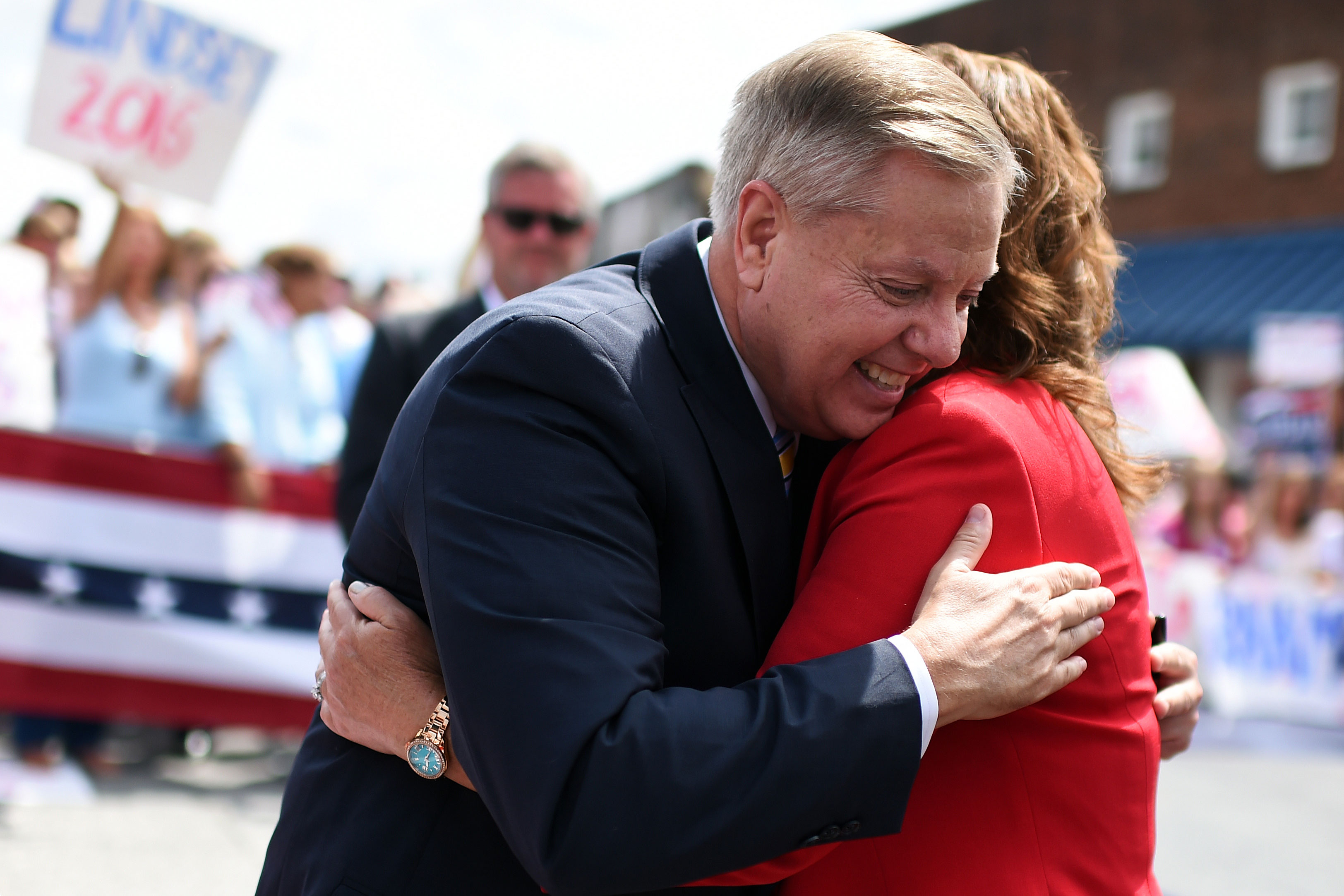
Graham was born in the city of Central, S.C., where her parents operated a combination bar, liquor store and pool hall called the Sanitary Cafe. The family lived in rooms behind the business.
Her mother died in 1976 after being diagnosed with Hodgkin lymphoma. She was buried the day before Darline Graham's 12th birthday, the Post and Courier reported.
Fifteen months later, her father died of a massive heart attack. Lindsey Graham was 22 and a senior at the University of South Carolina. Darline Graham, then 13, discovered their father's body after trying to wake him for school.
"I can remember the day my father passed away, standing in the living room of that house, absolutely scared to death," Darline Graham told NPR in 2015. "Lindsey wrapped his arms around me and promised me he would always be there for me and always take care of me."
Lindsey Graham kept the promise, returning home from Columbia nearly every weekend to look after his sister, who lived with relatives in nearby Seneca, S.C., where he kept tabs on her curfew and her friends.
"I never let her date. I smelled her clothes if she smoked. I listened in on her phone calls. I was probably pressing too hard, just 'cause I felt such responsibility for her," Lindsey Graham once told the Washington Post. "I thought that was my job and I felt very happy to have done it. She is the light of my life."
When Lindsey Graham joined the Air Force as a military lawyer, he became his sister's legal guardian and later adopted her so she would be eligible for his military benefits if anything happened to him.
"He's kind of like a brother, a father and a mother rolled into one," she said in a 2015 interview with the New York Times.
Darline Graham went on to become a mother of two, and her career has focused on helping people with disabilities. According to her LinkedIn profile, she served for over a decade as communications director for the South Carolina Vocational Rehabilitation Department, and has been commissioner of the South Carolina Commission for the Blind — which assists blind or visually impaired South Carolinians — since 2019.
"Of all the things that have happened in my life, her turning out so well is the highlight of it by far," Lindsey Graham told C-SPAN in 2015.
No stranger to politics

Although Darline Graham had never held public office, she was relatively active in supporting her brother's political ambitions, often appearing in his campaign ads.
"I have always looked up to Lindsey," she said in a campaign ad for his 2014 reelection. "He's just always been there for me as long as I can remember. If I fell down and scraped my knee, Lindsey was the one I ran to."
And she was at his side when he launched his short-lived 2016 presidential campaign.
Lindsey Graham, who never married, told ABC News that if he were to win the White House, he would have a "rotating first lady," suggesting his sister and friends "could play that role if necessary."
Supporting a sibling who’s a senator is a very different task from being one yourself, as Darline Graham learned when she was abruptly thrust into the political spotlight following her brother’s death.
She’s faced questions about her lack of experience throughout her Senate campaign. That line of criticism became especially pointed following a primary debate in August, when she struggled to answer a question about the U.S. relationship with Taiwan, eventually telling the moderator, “I’m not that informed on national security.” In that same debate, she also mistakenly stated that South Carolina is home to 50 million people. The state’s true population is 5.6 million.
Despite those hiccups, and with a boost from President Trump’s endorsement, Graham won the Republican primary after defeating U.S. Rep. Ralph Norman in a runoff.
What does she stand for?
Like her brother, Graham is a conservative. But she’s farther to the right than he was on certain issues.
One of the biggest differences is on immigration. Lindsey Graham cosponsored a bill that would have given a path to citizenship to “Dreamers,” undocumented immigrants who came to the U.S. as children. He said he opposed Trump’s mass deportation agenda during the 2016 presidential election.
“My stance is a little bit stronger,” Darline Graham said in August. “I think it’s real simple. If you’re here illegally, you need to go back immediately.”
Both siblings supported Trump’s proposed slate of election reforms, the SAVE America Act, but Lindsey opposed eliminating the filibuster to get it passed in the Senate. Darline has said she supports getting rid of it.
On most other issues, Darline Graham’s positions align with her brother’s, which puts her squarely in the conservative wing of the Republican Party. She opposes abortion, is a strong supporter of gun rights, wants to make tax cuts in Trump’s One Big Beautiful Bill permanent and is against allowing transgender athletes to compete in girls’ and women’s sports.
Graham has pledged to “keep fighting every single day for President Trump's agenda.” Unlike some other Republicans in close Senate races, who have called for the president to end the war in Iran, she has stood by the president’s approach. She has also backed Trump’s tariffs on other countries.
“I will have President Trump’s back 100%,” she told the crowd at a rally in August.
What are her chances?
Polls showed Graham with a lead of about 7 percentage points shortly after she won the Republican primary. But that advantage shrank in the following weeks, and the polls have shown her Democratic opponent, Andrews, only slightly behind as Election Day has grown closer. A New York Times/Siena poll released Wednesday even showed the race effectively tied.
This article originally appeared on Yahoo News at https://ift.tt/hHGkUclfrom yahoo.com/news Top Stories https://ift.tt/hHGkUcl

No comments:
Post a Comment