Wednesday, November 18, 2026

Medicare's 2027 price hikes will take a bite out of retirees' Social Security checks

Medicare Part B premiums will rise by 3.2% in 2027, the Centers for Medicare and Medicaid Services announced Tuesday.

The standard premium will rise by $6.50 per month to $209.40, totaling a $78-per-year increase. 

The 2027 increase, far smaller than the nearly 10% increase enrollees faced in 2026, is in line with the 3.25% increase projected by Medicare's trustees.

According to the CMS, "The increase in the 2027 Part B standard premium and deductible is mainly due to projected increases in healthcare spending."

Here's what you need to know before the increases are applied in January.

The Medicare Part A deductible, which beneficiaries pay if they are admitted to the hospital, will rise by $40 to $1,776 in 2027.

The Medicare Part A premium will be $597 per month, a $32 increase from $565 in 2026. 

According to the CMS, it is paid by:

  • Anyone aged 65 and older with fewer than 40 quarters of coverage, plus certain people with disabilities.

  • Uninsured people aged 65 and older with fewer than 30 quarters, and certain people with disabilities who have exhausted other entitlements.

Those with at least 30 quarters (or a spouse with 30 or more quarters) will pay a reduced rate of $328. 

Roughly 9% of people with Part B pay an income-related surcharge on top of their monthly premium.

The annual deductible for all Medicare Part B beneficiaries will increase by $9 to $292 in 2027.

In 2027, individuals with modified adjusted gross income above $112,000, or couples filing jointly above $224,000, will pay more. At the top tier, individuals with an income of $500,000 or more and couples earning $750,000 or more will pay $711.80 a month.

Married people who live with their spouse but file separate tax returns pay the standard $209.40 Part B premium if their income is $112,000 or less. Above that, they pay a total of $670 a month, rising to $711.80 for those earning $388,000 or more.

A small group of kidney transplant patients can keep Part B coverage of immunosuppressive drugs for a standard premium of $125.70 a month.

Those with higher incomes who pay Part D premiums face separate income-related surcharges between $15.40 and $96.40 a month on top of their plan's premium. The surcharge is paid to Medicare and is either deducted from Social Security checks or paid directly.

People who have their Part B premium deducted from their Social Security checks will keep less of the cost-of-living adjustment next year.

For the average retiree, the $6.50 Part B increase will eat into the $75 monthly COLA boost, leaving them with about $68.50 more a month.

Most beneficiaries will have the standard $209.40 Part B premium withheld from their checks. Higher earners will pay more, with total monthly Part B premiums reaching as much as $711.80 and Part D surcharges up to $96.40.

This article originally appeared on Yahoo News at https://ift.tt/iloLVpX

from yahoo.com/news Top Stories https://ift.tt/iloLVpX

Rare encounter with isolated Indigenous people in Brazil raises fears for their safety

BOGOTA, Colombia (AP) — A rare encounter between Indigenous people living in isolation in Brazil’s Amazon rainforest and members of a neighboring community has prompted government protections amid concerns about the group’s health and threats to its forest home.

The encounter began Monday near a government access control post and the Guajajara Indigenous village of Tawari in the northeastern state of Maranhao, according to a statement Tuesday from Brazil’s Ministry of Indigenous Peoples.

The ministry said around 20 members of the isolated Awa people had been sighted approaching the area in the Arariboia Indigenous Territory, but cautioned that information remained preliminary as authorities assessed the situation. The encounter has raised concerns about why members of a group that has spent decades hunting, fishing and gathering food while avoiding outsiders would suddenly approach a neighboring community, particularly as illegal logging, hunting and other intrusions threaten their forest territory. Images of the encounter have also drawn widespread attention.

Sarah Shenker, head of Survival Brasil, part of Survival International, an organization that advocates for Indigenous peoples’ rights, called the encounter “a crisis moment really and a wake-up call,” urging Brazilian authorities to crack down on illegal intrusions into Awa territory.

She said the images could help reinforce the existence of isolated Indigenous groups, whose presence is sometimes disputed by those seeking access to their lands. But she warned that the circumstances surrounding the encounter were troubling.

An unusual encounter with the isolated Awa people documented

Footage recorded by members of the neighboring Guajajara Indigenous community and shared by Survival International shows Awa adults and children gathered amid dense vegetation, some carrying bows and arrows and wearing feathered headdresses and necklaces.

The reason for the group’s approach remains unclear, but Survival International says the Awa apparently approached a government team, asked for yams and took them back into the forest.

The Arariboia territory has faced decades of pressure from illegal intruders, Shenker said, leaving isolated communities increasingly vulnerable as surrounding forests have been cleared.

The Brazilian government said the Awa group is already registered in the official database of isolated Indigenous peoples and is monitored by a specialized protection team from Funai, the federal Indigenous affairs agency. Funai personnel and Indigenous health workers are now in the area, and authorities have activated an emergency coordination mechanism to assess potential contact situations and health risks.

Survival International has previously estimated that around 100 Awa remain uncontacted, although that is not necessarily a current population count. Other Awa live in settled villages and maintain contact with outsiders.

Fears for the tribe's safety

One of the most immediate concerns is the risk of disease. Indigenous peoples living in isolation can be particularly vulnerable to infectious illnesses because of their limited previous exposure to pathogens common in the wider population.

The ministry stressed that its policy is not to encourage contact, but to protect the Awa’s right to remain isolated and determine for themselves whether to establish relations with outsiders. It also cautioned that a brief encounter does not necessarily mean a group has abandoned its isolation or chosen to establish permanent contact.

The Arariboia territory is also home to the Guajajara people, whose Indigenous forest guardians have spent years monitoring their lands and confronting illegal intrusions.

Shenker said those efforts have led to violence against the community, including killings of some community members, while responsibility for protecting the territory ultimately rests with the Brazilian government.

“The only way that they will survive is if intruders are kept out of their forest once and for all,” she said.

Despite the attention generated by the rare images, Shenker said she would rather the Awa had remained out of sight, living undisturbed in their forest.

“We would rather not have images and not have video footage of the uncontacted Awa when that means that they are living in the way that they choose in their forest, able to get on with their lives, hunting, fishing, gathering,” she said.

___

Reporter Gabriela Sá Pessoa in Sao Paulo, Brazil, contributed to this report.

___

The Associated Press’ climate and environmental coverage receives financial support from multiple private foundations. AP is solely responsible for all content. Find AP’s standards for working with philanthropies, a list of supporters and funded coverage areas at AP.org.

This article originally appeared on Associated Press at https://ift.tt/iNw0eb6

from yahoo.com/news Top Stories https://ift.tt/iNw0eb6

Iran attacks U.S. bases in Gulf countries despite diplomatic efforts to end 9-month war

By Enas Alashray and Nayera Abdallah

DUBAI, Nov 18 (Reuters) - Iran said it targeted US drone and missile sites in Kuwait overnight after the United States struck Qeshm Island in the Strait of Hormuz, marking Tehran's first attack on the US-allied Gulf state since September.

Underlining a broader uptick in hostilities in recent days, Bahrain said ‌it intercepted Iranian aerial attacks on Wednesday for a third time in a week, accusing Tehran of a "systematic hostile approach" towards the Gulf kingdom, where the US Navy's Fifth ‌Fleet is headquartered.

The latest attacks highlighted the obstacles facing diplomatic efforts to end a conflict that has destabilised the Middle East, disrupted shipping, driven up global energy prices and drawn in countries across the region.

IRAN ISSUES FRESH WARNING TO 'THE ENEMY'

The ​Iranian army said it had targeted US drone and missile installations at Kuwait's Ali Al Salem base after Kuwait said its air defences were countering hostile drone attacks.

It followed US airstrikes on Tuesday evening, when American fighter aircraft targeted a missile launch site on Qeshm in retaliation for Iranian attacks on US personnel and assets, a US military official told Reuters. Iranian media, citing an Iranian official, said the US attack caused no damage to infrastructure.

Kuwait said it reserved the right to take all necessary measures to safeguard its sovereignty and protect its territory and vital facilities against any aggression or threat.

In videos published ‌by state media on Wednesday, Iranian Army Commander-in-Chief Amir Hatami issued a ⁠fresh warning to the United States, which launched the war against Iran alongside Israel in February.

"If the enemy repeats its mistake... we have the readiness and the plans to confront it and its supporters in a stronger, more crushing way and without geographic limitations," he said.

Hasan Al Hasan, a senior ⁠fellow for Middle East Policy at the International Institute for Strategic Studies, said Iran was undertaking a "cautious" escalation.

"But there is no ruling out further escalation, especially if the US begins to widen military operations, begins to widen its target set to include not just Iranian military coastal infrastructure, but also more deeply within Iran," he said.

MEDIATOR QATAR AIMS TO NARROW GAPS

The United States and Israel attacked Iran on February 28 and Tehran responded ​with ​strikes on Israel and Gulf states hosting US military bases.

The conflict later spread to Lebanon, where fighting erupted ​between Israel and Iran-backed Hezbollah, and to Yemen, from where the Iran-aligned Houthis ‌have launched attacks on Saudi energy facilities, airports and other targets.

Iran has also fired at US forces in Jordan.

Global oil and gas prices have shot up with shipping through the Strait of Hormuz severely disrupted after Tehran declared it closed, while the US has imposed a naval blockade on Iran, hitting Iran's economy hard.

Qatari and Iranian officials met on Tuesday for talks aimed at "bridging perspectives and narrowing the gap between proposals presented on the ground," Qatari spokesperson Majed Al Ansari said.

A Saudi-led coalition said on Wednesday it had intercepted a cruise missile launched by the Houthis towards the Saudi capital Riyadh.

There was no immediate confirmation from the Houthis.

A surge in attacks on shipping since October has threatened to further strain global oil supplies. On Tuesday, a crew abandoned a liquefied petroleum gas ‌tanker off Oman's Khasab.

The United Arab Emirates' ADNOC L&S said on Wednesday that one crew member was missing and ​11 injured after one of its vessels was attacked in the Strait of Hormuz on Tuesday.

Saudi Arabia condemned Iran's ​latest attacks.

"The Kingdom renews its demand for an end to all acts of aggression, respect ​for international law and the principles of good neighborliness, and an opportunity for diplomatic efforts to achieve peace and resolve the crisis through negotiations," the ‌Saudi foreign ministry said.

RUBIO SEES NO IMMINENT THREAT TO WASHINGTON

Trump said on Tuesday ​the US was taking seriously the possibility that ​Iran could be planning an attack on Washington,  when asked about a CNN report that cited US intelligence assessments on a potential Iranian plot involving a so-called dirty bomb.

On Wednesday, US Secretary of State Marco Rubio said he did not think there was any imminent threat to the US capital.

Iran's Foreign Ministry denied the allegations, calling them "baseless."

A dirty bomb uses conventional ​explosives to disperse radioactive material. Unlike a nuclear weapon, it does not ‌produce a nuclear explosion, but can spread radioactive contamination and cause significant disruption and public alarm.

"I am not," Rubio said when asked by a reporter in Manila ​if he was concerned about an "imminent attack" on Washington. "I don't think there is any imminent threat."

(Reporting by Enas Alashray in Cairo; Jana Choukeir and Elwely Elwelly in Dubai; ​Writing by Nayera Abdallah and Tom Perry, Editing by Stephen Coates, John Mair and Ros Russell)

This article originally appeared on Reuters at https://ift.tt/vCuNoHn

from yahoo.com/news Top Stories https://ift.tt/vCuNoHn

Tuesday, November 17, 2026

Starbucks' Red Cup Day is here. What to buy to get a reusable holiday cup today.

Starbucks' Red Cup Day has arrived. Today, Nov. 17, customers who buy a holiday or fall drink at participating U.S. stores can get a limited-edition red reusable cup while supplies last.

The giveaway, which applies to iced, blended and hot drinks from the menu, will be available with orders placed in-store, through the Starbucks app, and via DoorDash, Grubhub, or Uber Eats.

This year's design, featuring an illustrated coffee tree branch and coffee cherries, will also give customers the chance to save and earn extra points. Customers who bring in a clean, reusable cup will get a 10-cent discount and double stars if they're a Starbucks Rewards customer.

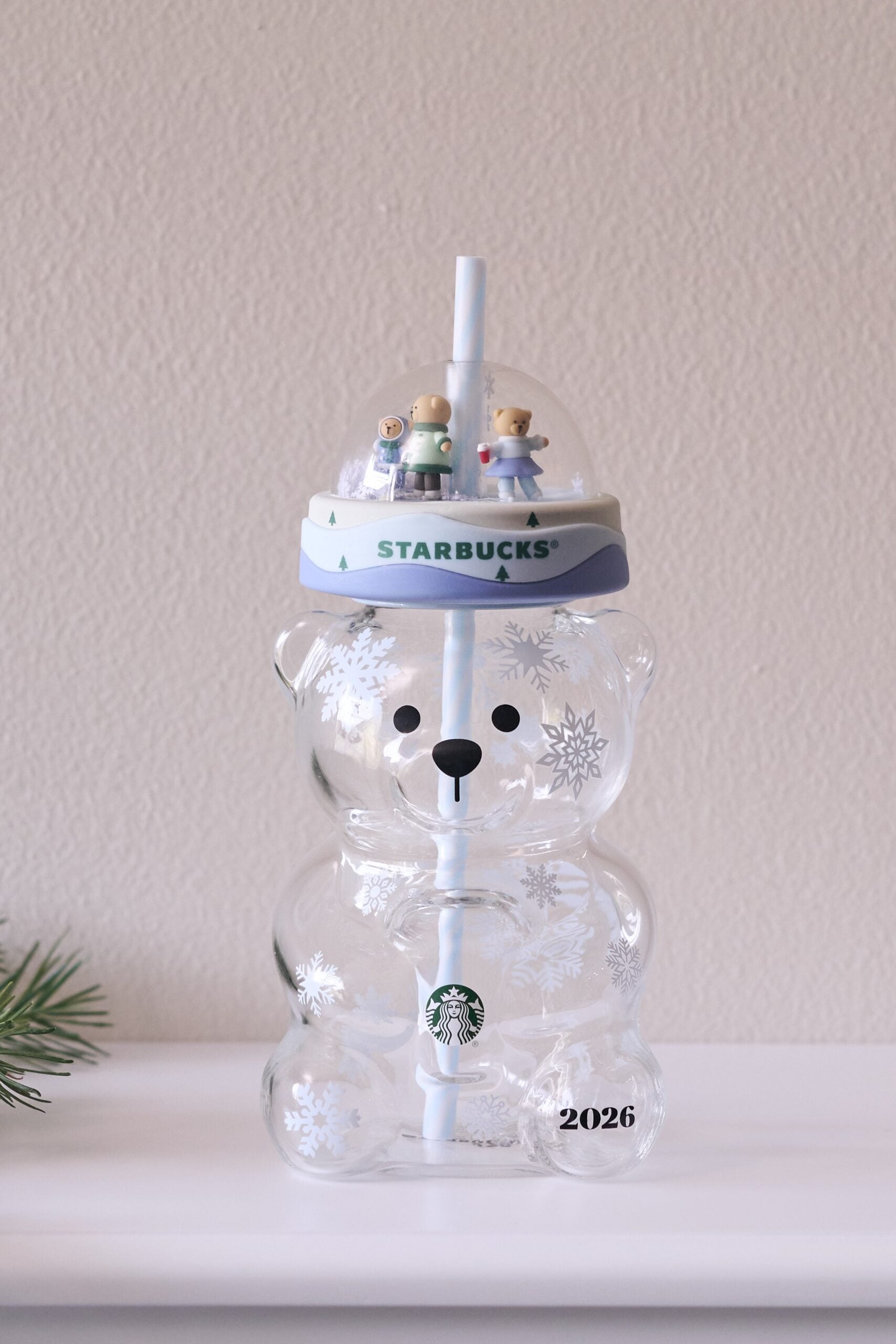
Today, the Winter Wonderland line also lands: a collection of drinkware in an icy blue-and-white color scheme. There's a quilted cold cup, iridescent water bottles and a snowglobe-topped mug, among other items. 

The first of Starbucks' 2026 seasonal offerings dropped Nov. 5, with the return of festive classics as well as the Tiramisu Velvet lineup debut, an Apple Pomegranate Refresher, and new sandwiches and treats.

Stores selling the Surprise Bearista cups, which launched Nov. 10, reported queues around the block to get the cups, echoing last year's frenzy. This year's $39.95 Surprise Box Edition went on sale at select coffeehouses with a limit of two per customer.

A new Bearista Cake Pop and Bearista-themed merchandise have been on sale since Nov. 5, and the original Bearista Glass Cold Cup is due back Dec. 1.

On Nov. 5, four seasonal favorites returned: the Peppermint Mocha, Caramel Brulée Latte, Sugar Cookie Latte and Gingerbread Chai.

The same date saw the launch of the new Apple Pomegranate Refresher, which Starbucks bills as featuring "crisp apple flavors and popping pomegranate-flavored pearls." There will be a creamier alternative available: a Snowy Apple variation, made with coconut milk.

Starbucks is launching new tiramisu drinks for the 2026 holiday season.
Starbucks

The new Tiramisu Velvet duo arrived on the same day. A twist on the traditional Italian dessert, the Tiramisu Velvet Latte will be available hot or iced, and the Tiramisu Velvet Cold Brew will finish off the collection. Both drinks are, according to Starbucks, topped with a velvet mascarpone cold foam and cocoa and coffee dusting. 

The Bearista Glass Cold Cup returns on Dec. 1, but only to select coffeehouses and while supplies last. The bear-shaped design once again features a green beanie-shaped lid and striped straw.

Ahead of the launch, a new Surprise Box Edition arrived on Nov. 10, featuring a range of five festive character cups made from hand-blown glass. Customers only knew which festive character their box contained after they'd made their purchase. Long queues to get hold of the limited-edition items were reported on the day.

The bears include Aspen, the ski bear; Reiny, the reindeer bear; Bunny, the snow bear; Joy, the ice skating bear; and Goldie, the Golden bear and rarest of the collection.

Bunny, the snow bear, joins four other festival pals in the Surprise Bear Box collection.
Starbucks

The holiday tree design cold glass cup was also available to purchase from Nov. 5.

On the same date, drinkware featuring the Bearista motif hit the shelves, along with a miniature plus bear on a keychain and other matching accessories.

For the full bear moment, you can pair your Bearista cup with a new Bearista Cake Pop this holiday season. The new cake pop, released earlier this month, is on sale for a limited time. So it's another holiday menu item to get while you can.

Other food items include two sandwiches: the new Braised Short Rib Grilled Cheese and the Turkey & Stuffing Sandwich, which Starbucks says features a new recipe. A sweet treat trio — the Cranberry Bliss Bar, Snowman Cookie and Sugar Plum Cheese Danish — will all be returning. 

This article originally appeared on Yahoo News at https://ift.tt/NjZmdc5

from yahoo.com/news Top Stories https://ift.tt/NjZmdc5

Sunday, November 1, 2026

ICE officer charged with hitting fleeing man with car expected to surrender

The Immigration and Customs Enforcement officer accused of intentionally striking a man in Houston earlier this month is expected to surrender on Monday morning, his attorney, David Lindenmuth told ABC News. 

Mario Alberto Morales was indicted by a grand jury in Houston on a charge of second-degree aggravated assault with a deadly weapon, according to the Harris County District Attorney's Office.

Lindenmuth said Morales did not intend to strike Miguel Parra Hernandez when he was pursuing him and another person who were attempting to flee on foot on Oct. 10.

KTRK - PHOTO: Law enforcement officials are at the scene after a man was struck by a vehicle driven by an ICE agent during chase, according to the Harris Courty Sheriff's Office, on Oct. 10, 2026, in Harris County, Texas.
ICE officer who struck man with vehicle during pursuit in Texas indicted: DA

“It was an accident. It was nothing more than accident, but the DA to score political points right before elections decided to bring charges,” Lindenmuth said. 

At a press briefing on Friday, Harris County District Attorney Sean Teare alleged that Morales' body-camera footage shows the officer "aggressively steered his vehicle" into Parra Hernandez.

The district attorney played graphic video from the officer's body-worn camera alongside surveillance footage of the incident during a press briefing.

The body-camera footage appears to show Morales behind the wheel, pursuing Parra Hernandez and another individual who are fleeing on foot. 

ICE officer who allegedly struck man in Texas with vehicle placed on administrative leave, agency says

"Got a runner, got a runner," the officer can be heard saying. "On foot. Both of them."

Seconds later, the body camera footage shows the officer appearing to turn his steering wheel toward the left. Authorities say that’s when the vehicle struck Parra Hernandez and then came to a stop.

Morales is then seen approaching Parra Hernandez, who is lying on the ground crying in agony, and moving his leg.

KTRK - PHOTO: Law enforcement officials are at the scene after a man was struck by a vehicle driven by an ICE agent during chase, according to the Harris Courty Sheriff's Office, on Oct. 10, 2026, in Harris County, Texas.

When asked about the video, Lindenmuth said Morales had two detainees in the back seat and was trying to avoid striking a vehicle and did not intend to hit him. 

“Clearly there is contact but the contact wasn’t intentional. It wasn’t knowingly,” Lindenmuth said. “It was in reaction to him trying not to strike a vehicle.” 

Lindenmuth said Morales served in the army, was a paratrooper, and is a Christian pastor who does missionary work overseas. 

ICE agent strikes man with car during pursuit in Texas, authorities say

He said he believes the charges against his client are politically motivated.

“This is a good man, so why are you attacking his character and his background? You know why? When you don’t have evidence, you have to vilify somebody,” he said. “So he has to make him the boogeyman, a monster, because he knows he cannot prove intent because there was none.” 

Speaking at the press briefing, the DA told reporters: "I've reviewed hundreds of cases, some very similar to this. The evidence that we have in this case is as clear as any that I've ever prosecuted or investigated."

Attorney Kim Bruno, who's representing Parra Hernandez, her client suffered fractures and nerve damage and underwent surgery following the incident.

“All he wants is accountability,” Bruno said. “He wants assurance that this will not happen to anybody else. He is so sympathetic, and all he cares about are the other people. But he is the one in the bed suffering.”

Parra Hernandez is currently detained and remains in federal custody at a rehabilitation facility.

According to Lindenmuth, Morales is a former corrections officer who enlisted in the Army. 

Morales also worked as a detention and processing officer at the Port Isabel Detention Center and worked with DHS as an ICE contractor, Lindenmuth said. 

He joined ICE as a federal immigration officer in August 2025, Lindenmuth said. 

This article originally appeared on Good Morning America at https://ift.tt/ufcBrC3

from yahoo.com/news Top Stories https://ift.tt/ufcBrC3

New satellite images of damage on U.S. bases offer fresh insight into Iran's strategy

WASHINGTON (AP) — Iran's strikes on more than two dozen U.S. bases in the Middle East focused on early-warning systems before hitting aircraft and buildings, causing billions of dollars in equipment damage, according to an Associated Press analysis.

The AP independently verified damage to American targets using satellite imagery from multiple providers and spoke to four regional officials who were briefed or have firsthand knowledge of what was hit. The AP found that, through August, more than 115 drone or missile strikes claimed by Iran or Iranian-backed militias damaged or destroyed structures on 26 military bases and other sites with U.S. equipment.

The AP found that Iran initially focused its attacks on aircraft hangars and systems that detect incoming strikes, clearing the way for further strikes on warehouses, troop housing and more.

The damage has significantly reshaped the American foothold in the Middle East, with two regional officials saying the U.S. has moved many of its assets out of the Persian Gulf. That includes aircraft, air defense systems, communications systems and other equipment crucial to base operations, one of those officials said.

The impact of the damage raises questions about American defenses in the region as President Donald Trump considers new strikes after Tuesday's midterm elections and Tehran has vowed major retaliation. A return to hostilities threatens additional costly damage to bases, which would heighten uncertainty about whether the United States will choose to rebuild its bases and equipment in the region when the war ends.

The AP's analysis offers new insight into Iran's strategy for its retaliation and what precisely has been damaged on U.S. bases during the eight-month war, going beyond the details that have been released in independent reviews, including from the Pentagon's inspector general. It found that from April 1 to June 30, Iranian strikes had damaged and destroyed hundreds of buildings and other structures on U.S. bases.

Such assessments provide the only overall snapshot because the Trump administration and the U.S. military have provided few details about the toll of the conflict on people and equipment, even putting measures in place to impede outside review, such as delays in the release of satellite images.

U.S. Central Command, which oversees operations in the Middle East, has refused to comment on or specify damage to bases or equipment, usually citing the need for operational security. The command did not comment for this story.

Pentagon spokesman Sean Parnell asserted that U.S. “forces and bases are well protected and America’s military is stronger than ever."

"Our service members in CENTCOM have everything they need to continue their historic success ensuring Iran never obtains a nuclear weapon,” Parnell said in a statement to the AP.

Here's what Iran targeted at US bases in the Middle East

Most of the Iranian attacks have been in Kuwait, while U.S. sites in Bahrain, Iraq, Jordan, Oman, Qatar, Saudi Arabia and the United Arab Emirates also have been targeted, the analysis of satellite imagery shows. The deadliest known strike on U.S. troops in the Iran war was in Kuwait, where six soldiers were killed in a drone attack at Port Shuaiba on March 1.

Ali Al Salem Air Base in Kuwait was struck at least 30 times, damaging or destroying at least 15 aircraft hangars, numerous warehouses and 10 buildings near a residential area.

Camp Buehring, also in Kuwait, faced even heavier losses. While Iranian attacks made most of its hangars inoperable, gathering places for troops sustained much more damage because the base had limited aircraft. Its gym was destroyed in March and a store for troops to buy products on the base was hit in late July.

A strike also has severely damaged the garage and dining room there, according to the two regional officials. They and two others, who are regional military officials, spoke to the AP on condition of anonymity to discuss sensitive details about the damage to bases.

While strikes were much heavier against Iran, American matériel losses were inevitable, said Raphael Cohen, director of the National Security Program at the RAND School of Public Policy. The way wars are fought today makes all militaries “susceptible to large-scale, cheap drone attacks,” he said.

“This should be a wake-up call for the United States,” Cohen said.

Iran focused on targeting US systems meant to detect incoming strikes

Iran launched its response to the war with accurate attacks on systems meant to detect and thwart incoming strikes, then broadened its targets to buildings and equipment that made U.S. bases useful and habitable.

Iran destroyed enclosures protecting U.S. radar systems at Camp Arifjan in Kuwait and Naval Support Activity Bahrain within the first two days of the war's start in late February. Additionally, Iran hit portable radars at Prince Sultan Air Base in Saudi Arabia and Muwaffaq Salti Air Base in Jordan.

Iran prioritized striking at the backbone of the U.S. air defense system, targeting key early-warning radars that are difficult and expensive to repair or replace, said N.R. Jenzen-Jones, director of the technical intelligence consulting firm Armament Research Services.

A radar was hit in Jordan and said to be destroyed. It was one of only 13 possessed by the Army globally, manufacturer Raytheon said. Budget documents show each costs about half a billion dollars.

Another radar in Qatar was damaged significantly, but it is unclear if it was destroyed. Purchased by the Gulf country in a 2013 deal valued at $1.1 billion, it appears to have been the only one in the region.

Hitting such sites was likely “intended to disrupt and degrade the U.S. and allies’ ability to respond to further strikes,” Jenzen-Jones said.

After hitting the radars, Iran launched more than 50 successful strikes on 18 locations with U.S. military equipment in the first month of the war, prioritizing areas with aircraft.

Iran damaged refueling aircraft, communication systems, fuel bunkers and troop accommodations at various bases, the two regional officials said. An Iranian strike on Prince Sultan Air Base in March damaged the back half of a Boeing E-3 Sentry surveillance aircraft and another hit a CIA unit at the U.S. Embassy in Riyadh.

A separate regional military official, who recently visited the Saudi air base, described a severely damaged facility with scattered debris and broken construction materials. He said he saw damaged equipment, including bombed-out barracks and mess halls.

The official said the attack that hit the surveillance plane also damaged several other aircraft, including two aerial refueling tankers. A Congressional Research Service report updated in October said 15 U.S. aircraft had been damaged on regional bases.

Al Dhafra Air Base, about 20 miles (32 kilometers) south of Abu Dhabi in the UAE, was hit frequently early in the war, according to a second regional military official with direct knowledge of the damage. The official noted damage to infrastructure like aircraft hangars and other installations as well as to equipment such as an early-warning radar system and surveillance drones.

Satellite imagery has been delayed

Major providers with U.S. contracts have blocked or delayed public release of satellite imagery at the request of American officials, who sometimes cited it being a national security risk. That has left limited options to visually confirm strike damage until imagery could be obtained from OneAtlas, a satellite provider owned by Airbus.

In the example of Camp Buehring in Kuwait, one of the hardest-hit bases, high-quality imagery from reliable providers was not available until late August. From the halt of imagery in early March to its reemergence in August, more than 30 structures on the base were damaged or destroyed. The AP confirmed that Iran struck Camp Buehring numerous times in March, April, May and July.

Months later, no endgame for the war has been articulated, and more damage could be ahead if hostilities resume, which the U.S. and Iran both say is possible.

The conflict could foreshadow a new reality for U.S. forces.

“This is the operating environment that we’re going to face in the future," said Cohen, the RAND analyst. "The idea that we can rely on fixed infrastructure in the way that we have during the global war on terrorism is over.”

___

Magdy reported from Cairo.

This article originally appeared on Associated Press at https://ift.tt/TPvxwUS

from yahoo.com/news Top Stories https://ift.tt/TPvxwUS

1 person killed and 8 others injured in Alabama shooting after football game

At least one person was killed and at least eight others were injured in a shooting after a football game at Birmingham, Alabama, law enforcement said.

At least one person was detained in connection with the shooting, the Birmingham Police Department said.

"Shortly after 7:50 p.m., multiple shots rang out in the 400 block of Grayman Avenue West, officers responded and located multiple gunshot victims," Officer Darrell Freeman said during a press conference.

Freeman said nine people had been hit by gunfire, including "at least one being confirmed deceased." Another of the injured was in critical condition, he added, and seven others were in stable condition.

"Multiple firearms were recovered from the scene by officers and turned into our property room," Freeman said. "One person has been detained and transported to the Birmingham Police Headquarters for questioning. This is an active scene with developing information."

The shooting was near Legion Field, which hosted the Magic City Classic football game earlier on Saturday.

"This did occur after the game," Chief Michael Pickett said. "For the most part, it was off of the property."

This article originally appeared on Good Morning America at https://ift.tt/gG1RuaP

from yahoo.com/news Top Stories https://ift.tt/gG1RuaP

Alaska Republicans push back on Trump's bid to block Senate election results

Dan J. Sullivan standing out doors holding a green mug. (Becky Bohrer / AP)
Alaska officials criticized the legal basis on which the Trump administration has argued it has standing to intervene in the election. (Becky Bohrer / AP)

The Republican-led state government in Alaska implored a federal judge on Saturday to permanently dismiss the Trump administration’s lawsuit that seeks to block the certification of the Alaska Senate race if GOP Sen. Dan S. Sullivan loses.

“The United States’ opposition provides no reason for this Court to entertain this meritless lawsuit any longer,” the filing said, adding that “the relief demanded is inappropriate and not even possible given Alaskan voters’ vital right to ballot secrecy.”

The filing from Alaska officials comes just three days before Election Day and as the judge is expected to rule soon on whether to dismiss the lawsuit or continue with it.

The Trump administration has claimed that Democratic Senate candidate Mary Peltola’s campaign was involved in recruiting a retired teacher with the same name as Sullivan to run in the race, creating confusion that it says will unfairly take away votes intended for the incumbent. Peltola has denied the allegations.

The Trump administration filed a lawsuit Oct. 22 against local election officials, arguing that the results of the competitive Senate race should not be certified unless Sen. Dan S. Sullivan is declared the winner.

Alaska officials on Saturday criticized the legal basis on which the Trump administration has argued it has standing to intervene in the election, as election certification is left up to the states.

The filing noted that the Alaska Supreme Court approved the second Sullivan’s name to be on the ballot months ago and added that “state officials carefully designed the ballot to minimize voter confusion.”

Alaska officials also took aim at the Justice Department’s proposal of “segregating” ballots that rank Dan J. Sullivan, writing, “this unexplained idea makes no sense.”

“No matter how the ballots are physically stored, it will be easy to tell which ballots rank Daniel J.,” the filing said. “If the United States means something different — as it seems to — its ballot segregation proposal is both disturbing and impossible.”

The Alaska attorney general’s office asked the judge to “immediately dismiss this lawsuit with prejudice and allow state officials to conduct the general election — including ballot counting and certification — free from unwarranted federal interference.”

The Trump administration amended its complaint this week to cite new reporting from The New York Times, which alleged that Peltola’s campaign was involved in recruiting Dan J. Sullivan and that Peltola herself was aware of the situation. The Times story citied a former campaign manager who later attempted to retract her statements.

At a rally Friday night, Peltola told a crowd of her supporters that she was “so deeply offended by these accusations about having any involvement with anyone else’s candidacy.”

“I want fewer candidates in the primary. I’m not out soliciting more competition,” Peltola said, adding she did “not need any help” defeating Sen. Dan S. Sullivan.

Sen. Dan S. Sullivan took aim at Peltola in a Fox News interview on Saturday, saying that “there’s no way Peltola doesn’t know about” the scheme to recruit Dan J. Sullivan.

“It’s deception. But at its worst, it’s disdain for us Alaskans,” he said. “Think about what they did. They’re trying to make sure that Alaskans throw away their vote.”

This article was originally published on NBCNews.com

This article originally appeared on NBC News at https://ift.tt/iK0BlCf

from yahoo.com/news Top Stories https://ift.tt/iK0BlCf

Saturday, October 31, 2026

El-Sayed campaign wants Stevens to stay away after day of back-and-forth barbs

TRAVERSE CITY, MICHIGAN — Michigan's Democratic coalition is fragmenting in real time days before a critical Senate election.

After it seemed like former primary rivals Abdul El-Sayed and Rep. Haley Stevens might finally appear together, they’re back to sniping at each other. And it could hardly come at a worse moment as Democrats look to unite behind El-Sayed and hold on to a pivotal Senate seat.

El-Sayed’s campaign is asking Stevens to stay away from all future campaign events in the closing days of the race, two people familiar with the decision, who were granted anonymity to discuss sensitive campaign dynamics, told POLITICO.

She should stay away “as not to distract from the central issues of the campaign,” one of the people said.

The brushoff capped a day of the two lobbing increasingly pointed statements back and forth at each other, frustrating Democrats who say the infighting risks imperiling a state the party can hardly afford to lose as they try to flip control of the Senate.

“I have no idea what the hell Haley Stevens is doing. This is a moment where we have to recognize the stakes,” Michigan state Sen. Mallory McMorrow, who was squeezed out of the Democratic primary by the two other candidates, told CNN earlier on Friday, before El-Sayed issued his response. “People are not talking about ads. They are not talking about Haley Stevens. They are talking about the price of gas and groceries.”

Stevens did not immediately respond to a question on if she will now stay off the trail, and did not respond to an earlier question about whether her appearance was contingent on him apologizing. El-Sayed’s campaign declined to comment.

El-Sayed narrowly defeated Stevens in a bitter and hard-fought primary in August that exposed division over support for Israel. The seat now held by the retiring Democratic Sen. Gary Peters is crucial to Democratic hopes to take control of the Senate.

Stevens and El Sayed have not campaigned together since a post-primary unity breakfast, but appeared on the verge of doing so earlier on Friday.

Stevens initially said she would appear alongside El-Sayed and South Carolina Rep. Jim Clyburn at a church in Detroit on Sunday.

But she said she expected the Democratic nominee to apologize for some of his past comments and condemn an ad run by an outside group supporting him that she described as antisemitic. The ad featured a conversation in a grocery store where a woman told a man they couldn't buy eggs because they had to set aside money for “killing Palestinians.” El-Sayed’s campaign had previously noted he was not affiliated with the ad.

In response, El-Sayed did not touch on the ad or his past comments on Israel, instead saying that his campaign “has always been focused on addressing the most critical challenges Michiganders are facing” and that that focus “is why our people-powered campaign defeated a historic $70 [million] in outside spending from big corporations and AIPAC on behalf of Congresswoman Stevens.”

“So while Congresswoman Stevens seems intent on relitigating a primary that ended three months ago, let’s all focus on the task at hand: that’s beating Mike Rogers,” El-Sayed said.

Privately, Democrats are frustrated — some with Stevens.

“Every Democrat was singing the same tune but now, because one person is tone deaf, the whole choir is thrown off,” said a Michigan Democratic operative who is not directly working for El-Sayed’s campaign.

Some Democrats tried to downplay the fight heading into the final days of the race.

“There’s been a lot of efforts to coalesce Democrats, both from Abdul and from the congresswoman. I think everybody's on the same page of Democrats just beating Mike Rogers," said Joe Tate, a state representative from Detroit who supported Stevens in the primary and is now backing El-Sayed. But he acknowledged that "when you have people that have competed through a primary, I know it can always have those lingering effects."

Former Transportation Secretary Pete Buttigieg urged Democrats to come together to support El-Sayed.

“I've never met somebody who I agree with on 100 percent of everything,” Buttigieg told reporters while campaigning in the state for House candidate Callie Barr on Friday. “But when our health care is at stake, when a chance to have a more affordable everyday life is at stake, the choice is clear: Mike Rogers has disqualified himself.”

Republicans have sought to play up the Democratic divisions. Rogers, in a Friday evening post on X, called Stevens a “courageous leader” and said she was “absolutely right” to call on El-Sayed to apologize.

“I agree with her and my campaign is about being there, showing up and defending these communities and all Michiganders,” Rogers said.

President Donald Trump, at a Friday night rally in Daytona, Florida, had a characteristically blunt message: "If you're Black, or if you're Jewish, and you vote for Abdul, you're not smart,” he said.

Stevens’ comments so close to the pivotal election left some Democrats wondering what her goal was.

“If you are someone with a large platform — whether you are, say, an outgoing member of Congress or an out-of-state streamer — who genuinely wants Abdul El-Sayed to become the next U.S. Senator from the state of Michigan and for Democrats to take back the Senate and put a meaningful check on Donald Trump, before you speak publicly I would implore you to ask yourself ‘is what I’m doing actually helping, or am I just seeking attention?’,” Democratic operative Adam Carlson, who has polled for a pro El-Sayed super PAC, wrote on X.

Sophia Cai contributed to this report.

This article originally appeared on Politico at https://ift.tt/m5vDCOT

from yahoo.com/news Top Stories https://ift.tt/m5vDCOT

A Senate seat Republicans have held for 60 years is suddenly up for grabs

When South Carolina’s longtime Republican Sen. Lindsey Graham died suddenly in July, his sister Darline stepped in to fill his seat in the Senate for the final six months of his term. 

“Lindsey has always been there for me, and now I will be there for him,” Darline Graham said in her first remarks after being appointed to her brother’s old seat.

The choice to put Darline Graham in the seat was made by South Carolina Gov. Henry McMaster. But now that Darline Graham is seeking election to a full six-year term, her political future is in the hands of South Carolina’s voters.

The Palmetto State hasn’t elected a Democrat to the Senate since 1998. The specific Senate seat Graham now occupies has been held by a Republican for more than 60 years. But polls suggest that, in a midterm cycle in which the GOP is playing defense in red states across the country, Graham’s Democratic opponent, Annie Andrews, may have a genuine chance of pulling off an upset on Nov. 3.

The 2026 midterm election will be held Nov. 3

Here’s what to know about Darline Graham as she fights to defend what could be a critical seat in the nationwide battle over control of the Senate. 

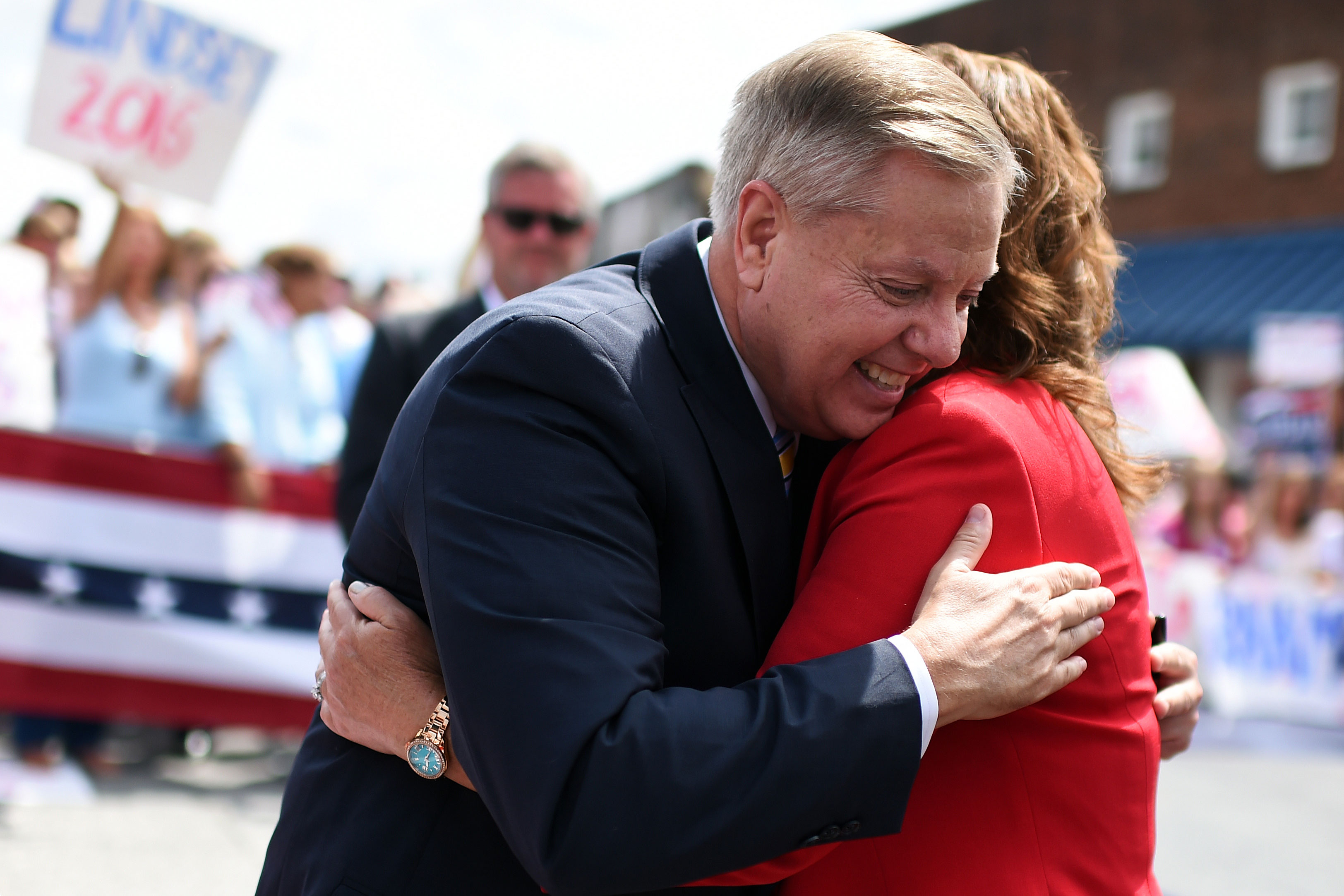
A man and a woman hug.
South Carolina Sen. Lindsey Graham hugs his sister, Darline Graham, after announcing his bid for the presidency, on June 1, 2015, in Central, S.C.
Rainier Ehrhardt/AP

Graham was born in the city of Central, S.C., where her parents operated a combination bar, liquor store and pool hall called the Sanitary Cafe. The family lived in rooms behind the business. 

Her mother died in 1976 after being diagnosed with Hodgkin lymphoma. She was buried the day before Darline Graham's 12th birthday, the Post and Courier reported.

Fifteen months later, her father died of a massive heart attack. Lindsey Graham was 22 and a senior at the University of South Carolina. Darline Graham, then 13, discovered their father's body after trying to wake him for school.

"I can remember the day my father passed away, standing in the living room of that house, absolutely scared to death," Darline Graham told NPR in 2015. "Lindsey wrapped his arms around me and promised me he would always be there for me and always take care of me."

Lindsey Graham kept the promise, returning home from Columbia nearly every weekend to look after his sister, who lived with relatives in nearby Seneca, S.C., where he kept tabs on her curfew and her friends.

"I never let her date. I smelled her clothes if she smoked. I listened in on her phone calls. I was probably pressing too hard, just 'cause I felt such responsibility for her," Lindsey Graham once told the Washington Post. "I thought that was my job and I felt very happy to have done it. She is the light of my life."

When Lindsey Graham joined the Air Force as a military lawyer, he became his sister's legal guardian and later adopted her so she would be eligible for his military benefits if anything happened to him.

"He's kind of like a brother, a father and a mother rolled into one," she said in a 2015 interview with the New York Times. 

Darline Graham went on to become a mother of two, and her career has focused on helping people with disabilities. According to her LinkedIn profile, she served for over a decade as communications director for the South Carolina Vocational Rehabilitation Department, and has been commissioner of the South Carolina Commission for the Blind — which assists blind or visually impaired South Carolinians — since 2019.

"Of all the things that have happened in my life, her turning out so well is the highlight of it by far," Lindsey Graham told C-SPAN in 2015.

A woman and a man smile for the camera.
Presidential candidate and South Carolina Sen. Lindsey Graham photobombs a local weatherman's live television shot beside his sister, Darline Graham, as he walks down the midway at the Iowa State Fair in Des Moines, Iowa, in 2015.
Al Drago/CQ Roll Call via Getty Images

Although Darline Graham had never held public office, she was relatively active in supporting her brother's political ambitions, often appearing in his campaign ads.

"I have always looked up to Lindsey," she said in a campaign ad for his 2014 reelection. "He's just always been there for me as long as I can remember. If I fell down and scraped my knee, Lindsey was the one I ran to."

And she was at his side when he launched his short-lived 2016 presidential campaign.

Lindsey Graham, who never married, told ABC News that if he were to win the White House, he would have a "rotating first lady," suggesting his sister and friends "could play that role if necessary."

Supporting a sibling who’s a senator is a very different task from being one yourself, as Darline Graham learned when she was abruptly thrust into the political spotlight following her brother’s death. 

She’s faced questions about her lack of experience throughout her Senate campaign. That line of criticism became especially pointed following a primary debate in August, when she struggled to answer a question about the U.S. relationship with Taiwan, eventually telling the moderator, “I’m not that informed on national security.” In that same debate, she also mistakenly stated that South Carolina is home to 50 million people. The state’s true population is 5.6 million. 

Despite those hiccups, and with a boost from President Trump’s endorsement, Graham won the Republican primary after defeating U.S. Rep. Ralph Norman in a runoff. 

Like her brother, Graham is a conservative. But she’s farther to the right than he was on certain issues. 

One of the biggest differences is on immigration. Lindsey Graham cosponsored a bill that would have given a path to citizenship to “Dreamers,” undocumented immigrants who came to the U.S. as children. He said he opposed Trump’s mass deportation agenda during the 2016 presidential election. 

“My stance is a little bit stronger,” Darline Graham said in August. “I think it’s real simple. If you’re here illegally, you need to go back immediately.”

Both siblings supported Trump’s proposed slate of election reforms, the SAVE America Act, but Lindsey opposed eliminating the filibuster to get it passed in the Senate. Darline has said she supports getting rid of it.

On most other issues, Darline Graham’s positions align with her brother’s, which puts her squarely in the conservative wing of the Republican Party. She opposes abortion, is a strong supporter of gun rights, wants to make tax cuts in Trump’s One Big Beautiful Bill permanent and is against allowing transgender athletes to compete in girls’ and women’s sports. 

Graham has pledged to “keep fighting every single day for President Trump's agenda.” Unlike some other Republicans in close Senate races, who have called for the president to end the war in Iran, she has stood by the president’s approach. She has also backed Trump’s tariffs on other countries. 

“I will have President Trump’s back 100%,” she told the crowd at a rally in August.

Polls showed Graham with a lead of about 7 percentage points shortly after she won the Republican primary. But that advantage shrank in the following weeks, and the polls have shown her Democratic opponent, Andrews, only slightly behind as Election Day has grown closer. A New York Times/Siena poll released Wednesday even showed the race effectively tied. 

This article originally appeared on Yahoo News at https://ift.tt/hHGkUcl

from yahoo.com/news Top Stories https://ift.tt/hHGkUcl

Justice Department seeks to isolate Alaska ballots amid Senate race probe

ANCHORAGE, Alaska (AP) — The U.S. Department of Justice pushed Friday for a court order to isolate certain Alaska ballots to investigate potential voter confusion, while federal officials confirmed the existence of a criminal probe over a Senate candidate who shares a name with the Republican incumbent.

The dueling developments came days before Tuesday's ranked choice general election, in a race headlined by two-term Republican Sen. Dan Sullivan and Democratic former U.S. Rep. Mary Peltola. The race is among a handful nationwide expected to determine control of the Senate.

Alaska U.S. Attorney Michael Heyman told reporters in Anchorage that the investigation has been ongoing for several months, but recent revelations from The New York Times that Peltola’s campaign appeared to be involved in recruiting retired teacher Dan J. Sullivan have resulted in a “significant surge of law enforcement assets to Alaska.”

Separately, the Justice Department — as part of a lawsuit it filed last week — asked a judge to order that state elections officials isolate ballots ranking Dan J. Sullivan to investigate potential voter “confusion” with the senator. The owner of a boat dealership in the candidate's hometown of Petersburg who had donated to his campaign told The Associated Press that an FBI agent visited the business and wanted to know whether he had been misled by Dan J. Sullivan's candidacy. He said he had not and that “Everybody knows who the incumbent is.”

Alaska Assistant U.S. Attorney E. Bryan Wilson, in a filing, said the government “seeks to preserve and segregate all ballots ranking Daniel J. Sullivan for the purposes of investigating whether such ranking was the product of voter confusion, should such an investigation become necessary.”

The Department of Justice also filed with the court a list of proposed questions it seeks to compel the Peltola campaign and the Democratic Senatorial Campaign Committee to answer as part of the civil case seeking to block certification of the Senate race if the incumbent loses. President Donald Trump has said he told the department to file the case.

State elections officials made efforts to distinguish the two Sullivans on the ballot

Peltola denied Thursday that she knew anything about the effort to put Dan J. Sullivan on the ballot: “I am not interested in tricking voters,” she said.

Democrats, including the DSCC, have repeatedly denied that they were involved in any campaign trick. Dan J. Sullivan has long denied he was running at Democrats’ behest.

The request to segregate the ballots in Alaska comes after the 9th U.S. Circuit Court of Appeals rejected the Justice Department’s request for California to set aside disputed ballots received in the midterm election sent to some 20,000 people the administration contends may not be U.S. citizens. California officials argued the list is highly unreliable and most likely includes many people who are U.S. citizens.

Justice Department attorneys in the Alaska case said there is a “substantial risk” that Dan J. Sullivan's candidacy “will mislead voters and ultimately result in an electoral process that lacks integrity.”

“To guard against this danger, the United States seeks an order directing Defendants to preserve and segregate all ballots ranking Daniel J. Sullivan for the purposes of investigating whether such ranking was the product of voter confusion, should such an investigation become necessary,” the filing states. It requests a decision by Monday.

Attorneys for the state in response questioned how segregation would be possible, writing that voters' ballots are commingled in the ballot box on Election Day and that election workers couldn't segregate ballots ranking Dan J. Sullivan without violating ballot secrecy protections. Ballots segregated or not wouldn't reveal any voter's reason for voting for Dan J. Sullivan, they said.

They have asked a judge to dismiss the case and said Alaska elections officials already took steps to distinguish the two Sullivans on the ballot. The senator is listed as Dan S. Sullivan, Republican and incumbent, while the challenger is listed as Daniel J. Sullivan Jr., with no party affiliation. That's also how they appeared on the August open primary ballot.

Attorneys for the state also have argued that Alaska’s ranked voting system further addresses concerns about potential confusion by allowing voters to rank both Sullivans.

Timing of Justice Department announcements unusual

Heyman on Friday would not say what potential crimes authorities are looking into or the targets of the probe, but asked members of the public to come forward with tips that could help investigators.

It’s highly unusual for Justice Department officials to publicly discuss a criminal investigation or even confirm its existence. The timing of the press conference is particularly notable given the Justice Department has had a longstanding practice of avoiding taking public steps in the weeks leading up to an election that could be perceived as attempting to influence a political outcome.

Trump during a rally late Friday in Florida said Peltola and Dan J. Sullivan should be prosecuted. He noted U.S. Attorney General Todd Blanche was in attendance and said, “He’s going to make his own decision.”

Trump, then addressing Blanche directly, said of decisions regarding the case, “Todd, please make your own,” and watched Blanche’s response.

Trump added: “OK, he said ‘yes.’”

Peltola, at a campaign rally in Anchorage late Friday, said she is “so deeply offended by these accusations about having any involvement with anyone else’s candidacy.” She said she doesn't need any help in winning the race outside of the support of voters.

She was asked before the rally if it was possible that someone on her campaign was involved in recruiting Dan J. Sullivan: “I have no idea,” she told KTUU. “I honestly have no idea.”

The Times story revealing the potential recruitment of Dan J. Sullivan was based partly on interviews with a former campaign manager, Elisa Rios, who was fired before the August primary. Asked about Rios by the station, Peltola said certain people are “gone for a good reason. If I could fire them again, I’d be happy to fire them again.”

Federal prosecutors this week issued dozens of grand jury subpoenas and requests to preserve records, a person familiar with the matter told The Associated Press.

Republican Alaska Gov. Mike Dunleavy said, following The New York Times' reporting, that he'd ordered an investigation into whether any violations took place.

Meanwhile, the Alaska Democratic Party has sued state elections officials, alleging absentee in-person voting sites did not open as advertised in some rural communities. The director of the Division of Elections in a letter dated Monday said the agency signs agreements with local or tribal offices to operate the sites and that most of the 18 highlighted had opened. A message seeking comment from the state Department of Law was not immediately returned.

___

Durkin Richer reported from Washington. Bohrer reported from Juneau, Alaska. AP reporter Will Weissert contributed from Washington.

This article originally appeared on Associated Press at https://ift.tt/5L3ZD2B

from yahoo.com/news Top Stories https://ift.tt/5L3ZD2B

Friday, October 30, 2026

Election forecasters shift 12 more House races toward Democrats before Tuesday

It's crunch time. With just days to go until the 2026 midterm elections, Democratic and Republican candidates for the U.S. House of Representatives nationwide are making one last push to persuade voters in their districts — and help their party win or retain control of the chamber on Nov. 3.

The stakes are high. President Trump has enjoyed complete Republican control of Congress for the first half of his second term. Flipping the House would give Democrats the power to block parts of the president's agenda, investigate his administration and even impeach him (again).

Historically speaking, a president's party almost always loses seats when voters return to the polls to judge his first two years in office. (The average number lost since World War II? Twenty-six.) Sometimes, the backlash is so pervasive that the president's party loses seats across a wide range of competitive districts — a phenomenon known as a "wave" election.

But the past doesn't necessarily predict the future, and Republicans have certain advantages today that they didn't have before. Here's what needs to happen for each party to come out on top. 

The 2026 midterm election will be held Nov. 3

The first thing to know about any House election is that while all 435 congressional districts are technically up for grabs, roughly 80% of those contests (representing about 350 seats) are not considered competitive. 

House incumbents have always had huge advantages: money and name recognition, mostly. But their head start has only widened in recent years as partisan polarization and redistricting have helped make the vast majority of congressional districts "safe" for one party. These days, incumbents tend to focus more on fending off primary challengers. The general election can be a breeze in comparison.

As a result, this year's true battleground is relatively small. According to the nonpartisan Cook Political Report's "race ratings," just 18 contests are genuine "tossups" at this point. Another 18 "lean Democratic," and 17 "lean Republican." There's also a third competitive category that includes 18 seats where Democrats are the "likely" winners, and 14 seats where the same could be said about Republicans.  

That's 85 competitive districts — again, out of 435. 

It’s clear from looking at those ratings which party is playing more defense and which is playing more offense — and where. Only 30 Democratic-held seats are considered competitive, and more than half of them (17) are "likely" to remain Democratic, according to Cook. Just four Democratic seats are toss ups. Just three are leaning Republican.

In contrast, a full 55 Republican-held seats are considered competitive — and about half of them are tossups (14) or leaning Democratic (13). 

Geographically, this year's tossups are concentrated in certain kinds of places: Rust Belt districts in states that have swung from party to party in the past (such as Michigan, Pennsylvania and Ohio); Mid-Atlantic suburbs (in states such as New York, Virginia and North Carolina) where Trump has scrambled some of the usual coalitions; and Sun Belt districts (think Florida, Texas, California and Nevada) where Latinos factor heavily. Trump carried many of these areas in 2024.

On Friday, Cook shifted another dozen of its race ratings toward Democrats — part of a pattern that has seen the outlet move a total of 75 race ratings toward Democrats over the last month.

“As the House battleground map has expanded, Democrats now have the potential to win their largest majority since 2009. President Donald Trump’s approval rating is underwater even in deep red seats that he won comfortably in 2024, and heavy spending from Republicans doesn’t appear to be moving the needle,” Cook’s House analyst wrote. “While Democrats won’t reach the 257 seats they had following President Barack Obama’s election — a high water mark for them this century — they could surpass the majorities they had following the 2006 and 2018 blue wave cycles.”

She went on to project that Democrats “will flip 12 to 25 seats, giving them as many as 240 seats in the House.”

Overall, the map gives Democrats more pickup options — which means more paths to a House majority. 

Senate and governor contests can be quirky — more state-specific and personality-driven. But national dynamics tend to play a larger role in shaping the composition of the incoming House. 

So it's not just a matter of who has more targets on the board. It's that the board itself tends to tilt to one side or the other, taking most of those targets with it. A recent example was the 2010 midterm election, when impatience with America's slow recovery from the 2008 financial collapse and frustration with President Barack Obama's response helped Republicans gain 64 House seats. 

Beyond the history of midterm backlash against the president's party, Democrats have two big advantages right now. One is that the current Republican majority is so minuscule — just 219 votes to 214, including an independent who caucuses with Republicans — that Democrats only need a net gain of three seats to win back the House. 

The other is that the board seems to be tilting in Democrats' favor — assuming the polls are right. 

Surveys suggest there's one underlying factor pulling the national electorate to the left: dissatisfaction with Trump. According to the data journalists at Silver Bulletin, an average of 60% of Americans currently disapprove of how Trump is handling his job vs. 37% who approve. That puts the president's net approval rating at -23% — near his all-time low.

Trump is earning even lower marks on voters' top issue this year: the cost of living. Shortly after he returned to office, roughly equal numbers of Americans approved and disapproved of how the president was handling inflation. But today — as tariffs and the Iran war help drive prices up — 70% disapprove and 25% approve. That's a 45-point gap.

President Donald Trump arrives to speak at a campaign rally at F&M Bank Arena, Saturday, Oct. 10, 2026, in Clarksville, Tenn. (AP Photo/Alex Brandon)
President Trump arrives to speak at a campaign rally at F&M Bank Arena on Oct. 10, 2026, in Clarksville, Tenn.
AP Photo/Alex Brandon

Democrats aren't particularly popular. But for the party in power, it may be hard to overcome this level of dissatisfaction with the status quo. That's why, when pollsters ask their so-called generic ballot question — If an election for U.S. Congress were held today, which party's candidate would you vote for in your district? — Americans are currently giving Democrats a substantial lead of 9 percentage points, on average. 

Making matters worse for Republicans, that lead has expanded as swing voters who favored Trump in 2024 — including some Latinos and independents — say they're planning to vote Democratic.

To put a 9-point lead in perspective, Democrats were leading by an average of 7.5 points on the generic ballot at this point in 2018, with Trump as president and Republican majorities in the House and Senate. On Election Day, they picked up 41 seats and flipped the House.

If the polls are right, Democrats might win control of the House again.

But are the polls right? Recently, Republicans have pointed to some surprising survey results on the Senate side — including Democratic leads in rural red states such as Iowa, Kansas and Nebraska — to argue that pollsters might be misjudging public sentiment. 

They're not wrong to say the polls have missed in the past. Polling errors are commonplace; they happen in most elections. But they tend to be random and to change directions from one cycle to another. The Trump era has been a little different. In each of the three presidential contests that Trump himself has competed in, the final average of polls conducted before Election Day underestimated Republicans' performance in the popular vote by an average of 3.8 percentage points, according to data journalist Nate Silver. 

The theory is that a phenomenon called nonresponse bias — in which Democratic voters are more eager or available to respond to pollsters than Republican voters — might have made Democratic support look stronger than it actually was. 

Pollsters try to adjust for this by weighting their results — that is, using statistical methods to give less weight to respondents who are overrepresented demographically and more weight to respondents who are underrepresented demographically. But it's difficult to predict in advance who will show up on Election Day. 

This time around, there are signs that rural Republicans are not responding to pollsters in certain states.

Could that mean Republican candidates in those places will outperform their polling? Possibly. But experts say it may also mean that rural Republicans are less supportive of the GOP than they were in 2024 — potentially voting Democratic or staying home on Nov. 3. 

A voter walks towards his polling place during the state's primary election to choose candidates for the November midterm elections, in Cary, North Carolina, U.S., March 3, 2026.  REUTERS/Jonathan Drake
A voter walks toward his polling place.
REUTERS / REUTERS

After all, there's been virtually no polling bias toward Democrats in Trump era elections when Trump himself wasn't on the ballot. In fact, the polls since 2016 have overestimated Republican support in midterm elections (by an average of 0.2%) and off-year, special and runoff elections (by an average of 1.3%), according to Silver. 

Either way, pollsters aren't seeing signs of this rural effect in most states — and even if they were, it might make only a minor dent in Democrats' 9-point national lead. 

Redistricting is the other Republican advantage. House redistricting efforts typically take place every 10 years, after each new census reveals changes in population distribution. But last summer, Trump successfully pushed GOP legislators in Texas to pass new congressional district boundaries five years earlier than normal to help Republicans win five additional House seats in 2026. This kicked off a tit-for-tat cycle that saw nine states adopt new congressional maps for the midterms — some to benefit Democrats, others Republicans.

Now that the dust has settled, Cook projects that Republicans could win nine seats because of redistricting (in Alabama, Florida, Louisiana, North Carolina, Ohio, Tennessee and Texas), while Democrats could win five (in California and Utah). If that plays out, it would net the GOP four seats overall. 

It's not what Republicans initially hoped to gain from gerrymandering. "We're not gonna win all 13 of those redistricted seats. That's correct. We're not," GOP House Majority Whip Tom Emmer of Minnesota told Axios recently. But it's also not nothing. 

The hope for the GOP is that some combination of polling error and redistricting boost — along with a late influx of hundreds of millions of dollars to help defend districts Trump won in 2024 — will be just enough to preserve their slim House majority.

This article originally appeared on Yahoo News at https://ift.tt/TdQ7RsB

from yahoo.com/news Top Stories https://ift.tt/TdQ7RsB

Wednesday, October 28, 2026

Classified material missing from Epstein files, documents suggest

Attorney General Todd Blanche has long maintained that the so-called Epstein files, even those kept from the public, contain no secret information related to national security.

When the document releases began last winter, Blanche noted that the Epstein Files Transparency Act authorized withholding information in the interest of national security or foreign policy, but said, "no files are being withheld or redacted on that basis."

"There's not some tranche of super-secret documents about Jeffrey Epstein that we're withholding, we're actually not withholding anything based upon [national defense information]," said Blanche, who was deputy attorney general at the time.

But the contents of at least three documents in the massive tranche of files indicate classified information was included in files collected by the DOJ. 

One of the documents shows Blanche's Office of the Deputy Attorney General itself received classified material related to Epstein in March 2025. By law, material can only be classified for national security purposes. 

What exactly was classified and why remains a mystery. 

The Department of Justice says it collected 6 million pages of material and ultimately released over 3 million of those pages after reviewing for duplication, attorney-client privilege and relevance to Jeffrey Epstein. 

Congressional challenges and a lawsuit are casting doubts on the DOJ's claims and demanding the release of more documents that were held back.

Clues about classified material

Included among the Epstein files is an eight-page timeline of the FBI's New York office's initial efforts last year to track down and deliver its voluminous files to the Justice Department's Washington headquarters.

On March 25, 2025, one document shows delivery of "16 Epstein items to ODAG," referring to the Office of the Deputy Attorney General. Among them, items No. 2 and No. 6 are described as "Epstein Transparency Project - Classified Material" and "CDs with classified materials (x2)." 

The Epstein Transparency Project refers to the Justice Department's effort to review the files and redact, withhold or clear them for release. It is not clear what exactly was identified as classified. Each CD was likely capable of holding hundreds of megabytes of material.

Excerpt from a document listing

Also in the files is an email sent that same day from the unit chief of the National Security Classification Operations Unit — an office whose role is to review FBI documents for classification or declassification. The email includes an attachment labeled "Epstein - Classified Document Memo.docx." 

The body of the email says there were three documents "identified that remain classified." One was described as an "FBI document which is classified when see-through." A redaction obscures the unit chief's description of the other two documents.

The identity of the email's recipient is also redacted.

It's also not clear whether the two documents — the email and the list — are referring to the same classified material. 

Coding system reveals missing pages

A CBS News analysis of a numerical coding system used by the DOJ to organize the Epstein files offers clues about some of the documents the department has withheld. 

The codes don't reveal what's missing, but they do show where gaps exist, raising questions about the DOJ's explanation for why documents were withheld.

Among the missing documents are pages from Epstein's own financial records collected as evidence in a federal prosecution. 

Here's how it works: Documents from the Epstein files are labeled with a string of numbers beginning with the letters EFTA stamped on the bottom right-hand corner; EFTA stands for Epstein Files Transparency Act.

An evidence photo from the Epstein files, with its number circled in red in the lower right corner. / Credit: DOJ/Epstein files

Those are called Bates numbers — a common way of organizing massive document batches in legal cases. Every page receives its own number. In the Epstein files, the sequence goes from 1 to 2,858,498, which is the tally of approximately how many pages of documents were released. 

According to the DOJ, other documents — including court records and investigative files they've previously released — bring the total to over 3 million.

Alongside the Epstein files' Bates numbers are other, older coding numbers that appear on many documents. This indicates that those documents had previously been used in federal legal cases, potentially collected as part of an earlier subpoena.

For instance, Bates coding on some of the documents is from the Ghislaine Maxwell criminal case and was used to organize files given to Maxwell's legal team ahead of her 2021 trial as part of the discovery process. 

Other Bates numbers indicate documents were collected from Epstein's banks, including JPMorgan and Deutsche Bank, during the FBI's investigation into his trafficking activities. 

Two examples of Bates numbers starting with

Similar gap analyses have been done in the past by independent researchers. 

Missing financial documents

Finding gaps in these documents is a simple process of counting. 

In tens of thousands of instances, the main EFTA number will advance by one but the other Bates numbers advance by two or more. Those gaps indicate pages that had been there before were likely removed at some point after the DOJ obtained them. 

Take the images below: The EFTA number advances by one but the JPM-SDNY and SDNY_GM numbers advance by 2, as do the page numbers from the original document. 

Page numbers and previous coding suggest a gap in this document in the Epstein files. / Credit: DOJ/Epstein files

In another example, a series of around 4,500 images of checks from Epstein's accounts has gaps where 66 of those check images should be. Oftentimes the missing image is only the front or the back of the check, although in several cases both are missing. 

Images of checks from Epstein's accounts, with X's marking gaps in the files. / Credit: DOJ/Epstein files

Comparing all of these numbers against the final EFTA page numbers, it is possible to calculate that there are tens of thousands of pages of documents that are missing from these sections, with no clear reason why. 

"Financial records were not a permissible category for removal," Barbara McQuade, the former U.S. Attorney for the Eastern District of Michigan, told CBS News.

Like every federal prosecutor, she says she is very familiar with Bates numbers. "It's the reason you have Bates numbers, so you notice something like that," she said.  

The DOJ hasn't responded to CBS News' recent inquiries about the Epstein files, but it has previously said that every document required to be released by the Epstein Files Transparency Act has been released, and the remaining files were unrelated, privileged, or were duplicative.

Email gaps

Another sequence of Bates numbers that provide a map to where documents were removed appears to be from a preliminary processing of the files.

One large sequence of those have "R1" in between EFTA and the page number. 

An example of

This R1 numbering is found across approximately 995,000 released pages, between p. 61 and p. 2,214,171 in the files. Each page is also labeled with an EFTA page number. 

While the EFTAs are sequential, the R1s have gaps which range from 1 page to hundreds of pages. Each time a gap appears — for example, if the EFTA advances by 1 but the R1 advances by 2 — it's evidence that pages were removed. 

By comparing these sequences it's possible to identify gaps where documents, mostly emails, were removed between that earlier review and the final release. No partial emails turned up in the thousands of documents we examined, so the removals appear to be entire email exchanges.

Here's what a section of that looks like: 

Images of emails from the files, with X's marking gaps. / Credit: DOJ/Epstein files

The emails are not sequential in date and jump by days, months and years, so knowing what was removed from context is simply not possible. 

But the results of calculating the differences between the first and last of the numbers in this earlier sequence versus the later sequence is 1.2 million pages, which is the total number of identified gaps from just this one section.

Most of the documents in this section are emails to or from Jeffrey Epstein, including communication with young women who would later accuse him of abuse; email exchanges with his business associates; messages to or from his assistant, Lesley Groff; or emails sent or received by Ghislaine Maxwell.

"De-duping"

There is one possible explanation for many of the email gaps. Instructions given to DOJ attorneys working on processing the redactions state: 

"If the document is an email chain and the most-inclusive email (i.e., containing all the back-and-forth) has already been reviewed and redacted as appropriate for production, the interstitial back-and-forth can be marked as duplicates." 

In other words, all emails exchanged prior to the last email in a chain can be considered a duplicate, because the last one should include all of the messages, and eliminating the duplicates will speed up the redaction process. Once a document is marked as a duplicate, it would likely be excluded from the files. 

If that was the case, this was only partially accomplished because duplicate emails still exist throughout the files. 

There's also the possibility that errors in the process could have resulted in crucial emails mistakenly being deleted.

Lack of transparency

The review and redaction process was conducted by hundreds of DOJ attorneys working under a compressed timeline. Given the scale of the task, it's possible that pages were withheld as a result of honest mistakes. But without a roadmap to the redactions and removals, it's impossible to make that determination. 

Independent journalist Katie Phang is suing the Justice Department, seeking the release of more files as well as an explanation of redactions and removals. A federal judge has made several rulings in her favor and the DOJ is appealing those rulings. 

As part of her lawsuit, Phang is asking the court to appoint a special master to review the files.

"If it wasn't intentional, then was it gross negligence? Were you just lazy? If it was intentional then I think there's [expletive] there that they don't want people to see," Phang told CBS News. "My speculation runs an entire spectrum of reaction — but at the end of the day it just makes the DOJ look bad."  

The DOJ has acknowledged making several mistakes.

It admitted to removing, and then restoring, a photo of now Commerce Secretary Howard Lutnick on a 2012 visit to Epstein's island, contradicting claims Lutnick had previously made about his contacts with Epstein.

Last year, DOJ officials claimed a minute was missing from prison security video from the night Epstein died, which turned out to not be true.

"This is a case where the process has inhibited public trust in what is ultimately released, and there's a long tradition of this, whether it's the Pentagon Papers or the Epstein files," said attorney Stanley Brand, a veteran litigator and distinguished fellow in law and government at Penn State Dickinson Law.  

"This is just another piece where the government process, where making this stuff available just fuels suspicion that there's something we're not seeing, and I don't know that ever gets resolved."  

This article originally appeared on CBS News at https://ift.tt/kKJHjGd

from yahoo.com/news Top Stories https://ift.tt/kKJHjGd

Clickbank Ads